Why It’s Time to Have ‘The Talk’ About AI

Table of Contents
- The Talk We’ve Been Avoiding
- The Hidden Behaviour Problem
- The Architecture of Trust
- Transparency as Psychological Safety
- The Prompt Revision Session
- The Harvard Case Study
- Beyond Proof — The Cultural Shift
- The Talk, Revisited
The Talk We’ve Been Avoiding
There’s a moment every parent recognizes—the uneasy pause before The Talk. It’s never just about the topic; it’s about trust. It’s the point where silence feels riskier than speaking. We brace for awkwardness, not because we doubt our child’s integrity, but because we know the world they’re stepping into is changing faster than their judgment can keep up.
Schools are standing in that same moment with AI. Our students are experimenting, exploring, and hiding what they discover. We can sense the gap widening between what they’re learning and what we’re prepared to acknowledge, yet we still hope students will use AI technology responsibly if given the right guardrails. And like anxious parents, we try to manage the risk by tightening control—new rules, new detectors, new forms of supervision and stronger punishments.
"A student's world is changing faster than their judgement can keep up"
But control doesn’t restore trust; it just deepens the concealment. It is the system itself that teaches secrecy. When proof of learning is defined by polished outputs, students learn to protect the process that produced them. They hide the mess, the drafts, the prompts—the very signals that show growth. AI didn’t create this behavior. It automated it at scale.
The Talk we need now isn’t about policy or punishment. It’s about rebuilding trust into how learning happens. The real danger isn’t that students are using AI—it’s that our education system makes secrecy the most rational choice, breaking the connection between their actions and our teaching. In this vacuum of distrust and accusations, a dangerous reciprocity emerges: our suspicion of their work is met with their questioning of our relevance.
"Educators suspicion of students work is met with their questioning of our relevance"
Every generation faces its own version of The Talk. Ours just happens to be about intelligence itself—how we use it, share it, and prove it. And like all good conversations, it has to start from care, not control.
The Hidden Behaviour Problem
We’ve misnamed our problem. We call it an AI problem, but what we’re really facing is a Crisis of Silence.
The student who quickly closes a browser tab as you pass. The perfectly written paragraph that appears without a draft. These aren’t acts of rebellion; they’re signals of retreat—a quiet withdrawal from the shared work of learning. When the process disappears, teaching becomes guesswork.
Economists would call this a signaling failure: the signals used to demonstrate learning no longer correspond to the reality of learning. In The War Nobody Wanted, I described how schools and AI clash because they optimise for different proofs—AI for access, schools for legitimacy. What we’re seeing now is the moment both collapse. Students optimise for efficiency; schools double down on verification. Each side loses sight of what’s happening in between.
The result is a feedback loop of mistrust. Teachers tighten control; students hide more carefully. The proof of learning becomes a performance of compliance. Every new safeguard only reinforces the logic of concealment. Detection tools don’t restore authenticity—they industrialise suspicion.
In this silence, two quiet tragedies unfold.
Cognitive Amnesia: The student earns the grade but loses the learning. Knowledge that was never forged in their own struggle fades quickly. They can recall the answer but not reconstruct the path that led there.
Agency Erosion: A slow disconnection from their own work. The student becomes a curator of someone else’s ideas, a bystander to their own success. Asked, “What were you thinking here?” they often have no answer. Authorship dissolves.
The hidden behaviour problem isn’t AI misuse; it’s the normalisation of invisibility. The real threat isn’t the tool they’re using but the silence it amplifies. And every new rule, every punitive policy, only deepens that silence — confirming the fear that the process of learning is not a source of teaching, but of judgment.
The Architecture of Trust
If silence is the symptom, then trust is the missing infrastructure.
The crisis we face is not a loss of control, but a collapse in the bonds that make honest learning possible. Every interaction between students, teachers, and institutions rests on an invisible network of expectations—what adaptive leadership calls vertical, horizontal, and systemic trust. When those bonds weaken, communication collapses, and the system begins to defend itself instead of evolving.
Vertical Trust is the foundation. It’s the trust between student and teacher—the safety to reveal imperfect thinking without fear of judgment. Without it, any attempt at transparency risks becoming interrogation. When students don’t believe that their uncertainty will be met with guidance, they choose concealment over honesty. This is why the return of visibility cannot begin with policy—it begins with relationship.
Horizontal Trust sits across the teaching culture itself. It is the shared confidence that peers will interpret, not weaponize, a colleague’s openness. Without it, innovation becomes risk. Teachers hesitate to share their use or experiments with AI because they fear reputational damage or inconsistency in enforcement. The absence of horizontal trust turns professional judgment into isolation, and isolation breeds inconsistency—the very thing that confuses students about what is “allowed.”
Systemic Trust is the outer shell: the relationship between the school and the institutions that govern it—exam boards, universities, accreditation bodies. This layer defines the limits of “bounded transparency.” Schools can only model openness if the systems that evaluate them recognise new forms of proof. Otherwise, trust inside the classroom will always exist in tension with fear outside it.
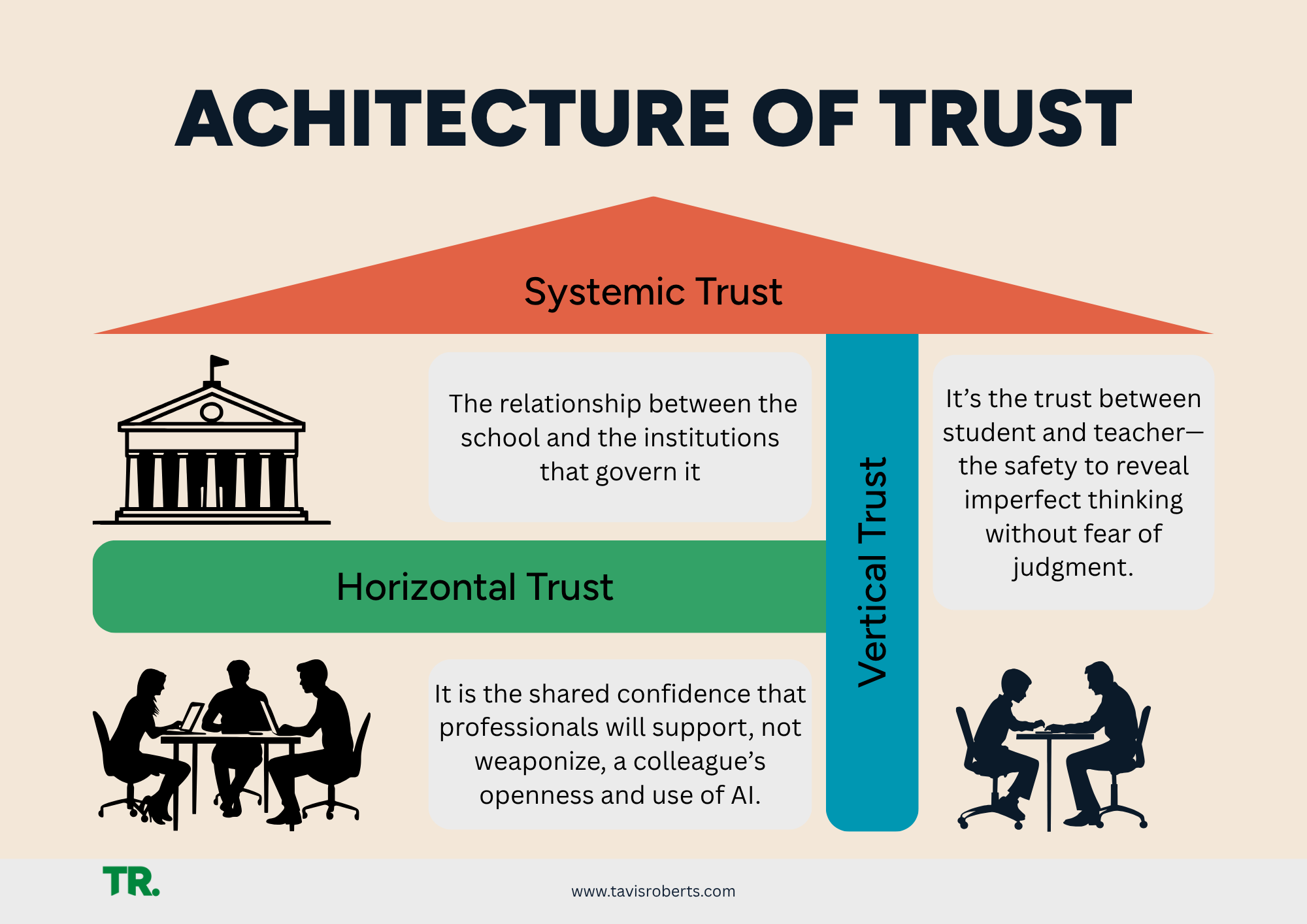
These three layers form a single architecture. Vertical trust enables honesty; horizontal trust normalises it; systemic trust protects it. A failure at any level weakens the others. When we detect, punish, or conceal, we are reinforcing a structure designed for control, not curiosity. But when trust flows across all three layers, something rare happens: the system begins to self-correct.
Trust does not eliminate risk—it redistributes it.
Teachers risk seeing the messy process again. Students risk showing it. Institutions risk loosening control in order to preserve credibility. But that’s the paradox: only by accepting the vulnerability of visibility can we rebuild the legitimacy of learning.
Transparency as Psychological Safety
We often mistake transparency for exposure—an act of surveillance or confession that invites a negative judgment. But in a healthy learning culture, transparency is something very different: it’s the shared understanding that showing one’s thinking will be met with curiosity, not correction. It’s what psychologists call psychological safety—the permission to be seen while still in progress.

When students feel that safety, disclosure becomes natural. They begin to narrate their choices, share unfinished ideas, and admit when an AI tool was part of their process. But when the atmosphere turns punitive, the same act of disclosure feels like stepping into a spotlight. The difference isn’t in the rule—it’s in the reaction.
Psychological safety is not the absence of standards; it’s the presence of context. In high-trust environments, transparency doesn’t lower expectations—it deepens them. A student who can explain why they used an AI output, what they kept, and what they rejected is demonstrating higher-order judgment. They are making their reasoning visible, not just their result.
For teachers, this kind of openness requires courage of its own. AI has quietly erased many of the “normal mistakes” that once helped teachers read a student’s understanding. When an essay arrives already fluent, those cues disappear—the false leads, the half-formed arguments, and incorrect answers. Without them, even experienced teachers are forced to operate closer to their own knowledge frontier, uncertain where to intervene. That’s why this kind of openness demands more than empathy—it requires professional courage to teach without the usual map, to question without judgment, and to learn alongside the learner.
When both sides participate, transparency transforms from a compliance exercise into a learning dialogue. The teacher’s role shifts from gatekeeper to guide—from verifying proof to cultivating discernment. This is the moment when the architecture of trust becomes operational. Vertical trust creates the safety, horizontal trust normalises it, and systemic trust protects it from collapse.
But safety is fragile. One sarcastic comment, one punitive policy, one public embarrassment can dissolve months of trust. That’s why cultures of transparency have to be designed, not assumed. They need space for reflection, language that separates judgment from guidance, and leadership that values relationships even when it’s inconvenient.
Transparency was never meant to expose the learner—it was meant to illuminate the learning. What matters most is not the polish of the product, but the honesty of the process—the small, visible choices that reveal judgment, discernment, and courage. The question now is how to design that visibility—how to make the process of thinking something we can see, question, and guide again.
The Prompt Revision Session
What does this architecture of trust look like in practice? How do we move from theory to a routine that rebuilds visibility? These questions have led to a simple but powerful idea: the Prompt Revision Session. It takes the familiar format of a writing conference and adapts it for a world where students now co-create with machines.
Vertical trust is the foundation—but without it, students will never show their source code. They will hide their process, fearing judgment. The teacher’s role is not to inspect that code, but to debug the thinking collaboratively—to trace the logic, question the decisions, and guide refinement through inquiry rather than evaluation.
In the traditional model, teachers reviewed drafts. In this model, they review decisions. Each prompt becomes a window into the student’s reasoning: why they asked what they asked, why they changed it, why they trusted or rejected the AI’s response. The goal isn’t to police the use of the tool, but to understand the student’s orchestration of it.
A single conversation can reveal what no rubric can.
- A prompt rewritten for clarity shows growth in metacognition—awareness of how questions shape understanding.
- A choice to include or exclude an AI paragraph reveals critical judgment—the discernment to decide what belongs.
- An admission of ethical hesitation shows moral reasoning—awareness of bias, influence, and consequence.
Each of these is proof of learning—not through output, but through transparency of process.
Visibility Question Framework
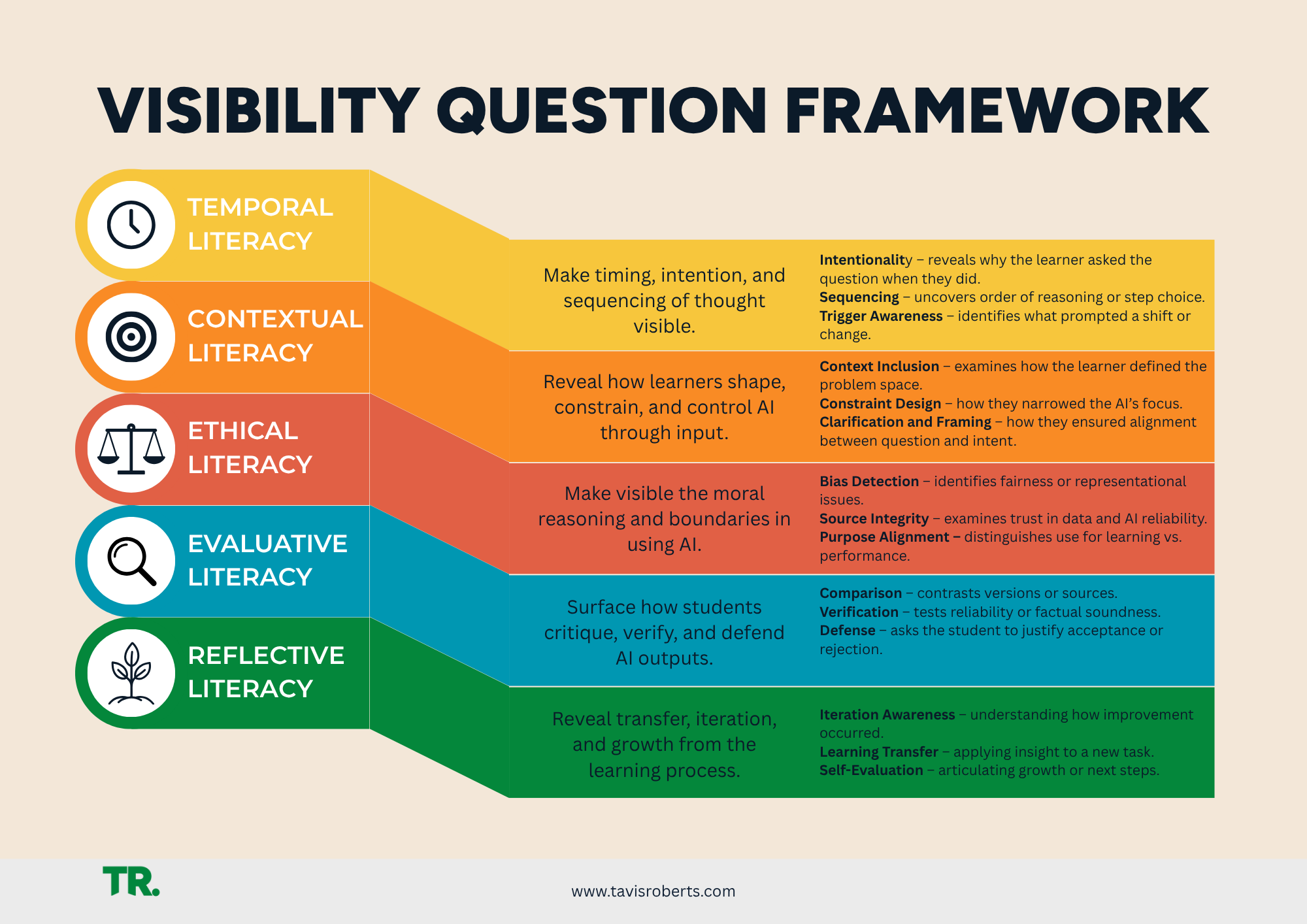
Each friction is explored through a Root Question—a foundational prompt that opens a family of related inquiries.
Unlike the Socratic Method, which guides students toward a known truth, Root Questions reveal the learner’s own reasoning and choices. They are diagnostic, not directive.
The Socratic Method seeks understanding; the Prompt Revision Method seeks visibility.
| Literacy / Friction | Root Question | What It Reveals |
| Metacognitive Friction (Temporal) | “What made you ask that question there?” | Reveals the student’s awareness of sequence and intentionality—the ability to pause and reflect on when and why a step was taken. |
| Cognitive Friction (Contextual / Precision) | “What context did you include to shape the AI’s thinking?” | Surfaces the student’s understanding of the cause-and-effect relationship between input quality and output relevance. It tests their skill in orchestrating the tool. |
| Ethical Friction | “What are the ethical considerations or potential biases in this answer?” | Forces moral reasoning to become visible; reveals how the student balances usefulness, fairness, and responsibility. |
| Evaluative Friction (Skepticism) | “Where did you agree or push back on the AI’s response—and why?” | Tests the student’s critical stance and independent judgment. It moves beyond passive acceptance to active evaluation, revealing their criteria for what makes an idea valid or useful. |
| Reflective Friction (Procedural / Growth) | “What would you change in your next prompt or approach?” | Captures learning transfer—the ability to iterate and apply improvement independently. |
Each Root Question converts what was once invisible—the student’s reasoning, doubts, and criteria—into observable learning moments. The teacher doesn’t assess the answers; they assess the thinking the answers reveal.
Teacher’s Diagnostic Vision
For teachers, these sessions reintroduce the cues that AI has erased. The half-finished thought, the incorrect prompt, the AI dead-end response—these fragments are once again visible, and therefore teachable. The teacher becomes a coach of discernment, helping students to refine not just what they produce, but how they think about producing it.
Across a faculty, these sessions also rebuild horizontal trust. Teachers share prompt logs, discussion protocols, and examples of reflective questioning. They begin to develop a common language for evaluating visible thinking. What starts as an act of individual dialogue becomes a culture of professional transparency—the same safety extended to students is mirrored among colleagues.
This practice doesn’t replace assessment; it redefines it. The essay or project remains, but it is now accompanied by a visible reasoning trail—a map of intellectual choices that make learning credible again. It’s a shift from grading the artifact to understanding the authorship.
The Harvard Case Study
The principles behind the Prompt Revision Session aren’t just theoretical; they are already being validated in high-functioning learning environments. A powerful example is the Harvard online courses, which operate as a large-scale prototype for the kind of trust-based, friction-rich system we need.
The course embeds three core literacies that directly mirror the frictions we’ve discussed:
- Temporal Friction: Content unlocks sequentially, forcing pause and reflection before progression. This restores the relationship between time and understanding.
- Contextual Friction: Case studies from unfamiliar domains (e.g., construction, opera) force learners to transfer concepts, turning knowledge into agile, transferable insight.
- Procedural Friction: Learning is verified through applied reflection exercises, not multiple-choice tests. Proof comes from the transparent trail of reasoning, not a polished final answer.
What makes this case so powerful isn't the brand name, but the structure. Harvard doesn’t rely on surveillance to ensure authenticity; it uses design friction to make dishonesty pointless. You can’t fake your way through a course that demands contextual transfer and personal reflection.
In this model, proof and process become the same thing. Trust is restored not by enforcement, but by design.
[➜ Read the full Harvard Adaptive Leadership Case Study for a detailed breakdown.]
Whether at the scale of a university course or a single classroom conversation, the pattern is the same: proof emerges from a designed process, not just a polished product. This shift in practice is the beginning of a deeper, cultural one. When a system begins to trust its own learners—and provides the structures to make that trust visible—the very nature of proof starts to change.
Beyond Proof — The Cultural Shift
When a system begins to trust its own learners again, something larger than assessment changes. The mechanics of grading may stay, but the value of polished proof starts to dissolve.
We are moving from the age of the notarized document—a single, polished, final product that is hard to fake—to the age of the blockchain—a transparent, distributed ledger of the process itself. The trust is no longer in the final coin (the essay) but in the verified history of every transaction (the prompts, revisions, and reflections) that created it. The artifact remains, but its authority now derives from the visible trail behind it.
Education’s current crisis was never just about AI or authenticity. By dismantling our old signals, AI has forced a deeper question into the open: what do we choose to believe about how people learn? For generations, we could avoid answering this directly, building schools around verification—tests, rubrics, invigilators—because visibility was hard. Now visibility is easy, but trust is hard. The old equation has been inverted.
The shift we are entering is not technical; it is adaptive and cultural.
From Compliance to Credibility
In the age of AI augmentation, compliance with traditional learning methods no longer signals effort; it signals a student’s rational fear of a system’s punishment. The schools that thrive will be those that cultivate credibility instead, where a learner’s authority comes from the coherence of their reasoning, not the perfection of their performance under threat of lower grades.
Credibility is slow to build and easy to lose. It is earned in the small acts of transparency: the prompt shared, the reasoning explained, the error owned. These are not technical adjustments but cultural adaptations that reshape what counts as success.
The Teacher’s Evolution
Authority is no longer proven by having the answer but by facilitating the dialogue that reveals one.
As AI begins to mirror and extend human reasoning, the teacher’s role is not diminished but redefined. They become less a judge of outputs and more a curator of insight—a guide who interprets learning signals in motion, reading not the text but the trajectory.
The best teachers will be those who can hold space for ambiguity—who can meet a student mid-process and see potential where others might see incompleteness. In this model, the teacher becomes a translator between human judgment and machine capability, ensuring that technology amplifies discernment rather than replacing it.
A New Learning Framework
This shift ultimately forges a new relationship between student and system. For the student, it restores agency. When the process becomes visible, the effort becomes meaningful again. The paralyzing question “Did you use AI?” is replaced by an empowering one: “How do you collaborate with AI?”
"Distrust and accusations are replaced with empowering questions"
For the system, it demands a move from credentials built on scarcity and hidden logic to those that reward visible reasoning. This means shifting from verifying learning through controlled isolation (exams, detectors) to credentialing learning through documented transparency (process portfolios, defense of reasoning). The outcome is a learner who is a co-author of understanding and a system that trusts the evidence of their journey.
The Cultural Equation
When we examine all layers—teacher, student, and institution—the challenge becomes clear: AI has made polished output abundant and effortless, eroding the credibility that once came from visible effort. To rebuild that credibility, we can no longer rely on the artifacts of learning alone; we must design for the integrity of the process itself.
Credibility (in the Age of AI) = Trust + Process Transparency + Designed Frictions + Human Judgment
- Trust creates psychological safety for students to reveal how they think, not just what they produce.
- Process Transparency—through prompt trails, reflections, and visible decision-making—makes reasoning traceable again.
- Designed Frictions in time, context, ethics, collaboration, and procedure test the integrity of ideas rather than the endurance of compliance.
- Human Judgment—teachers interpreting, questioning, and coaching discernment—anchors the system in meaning.
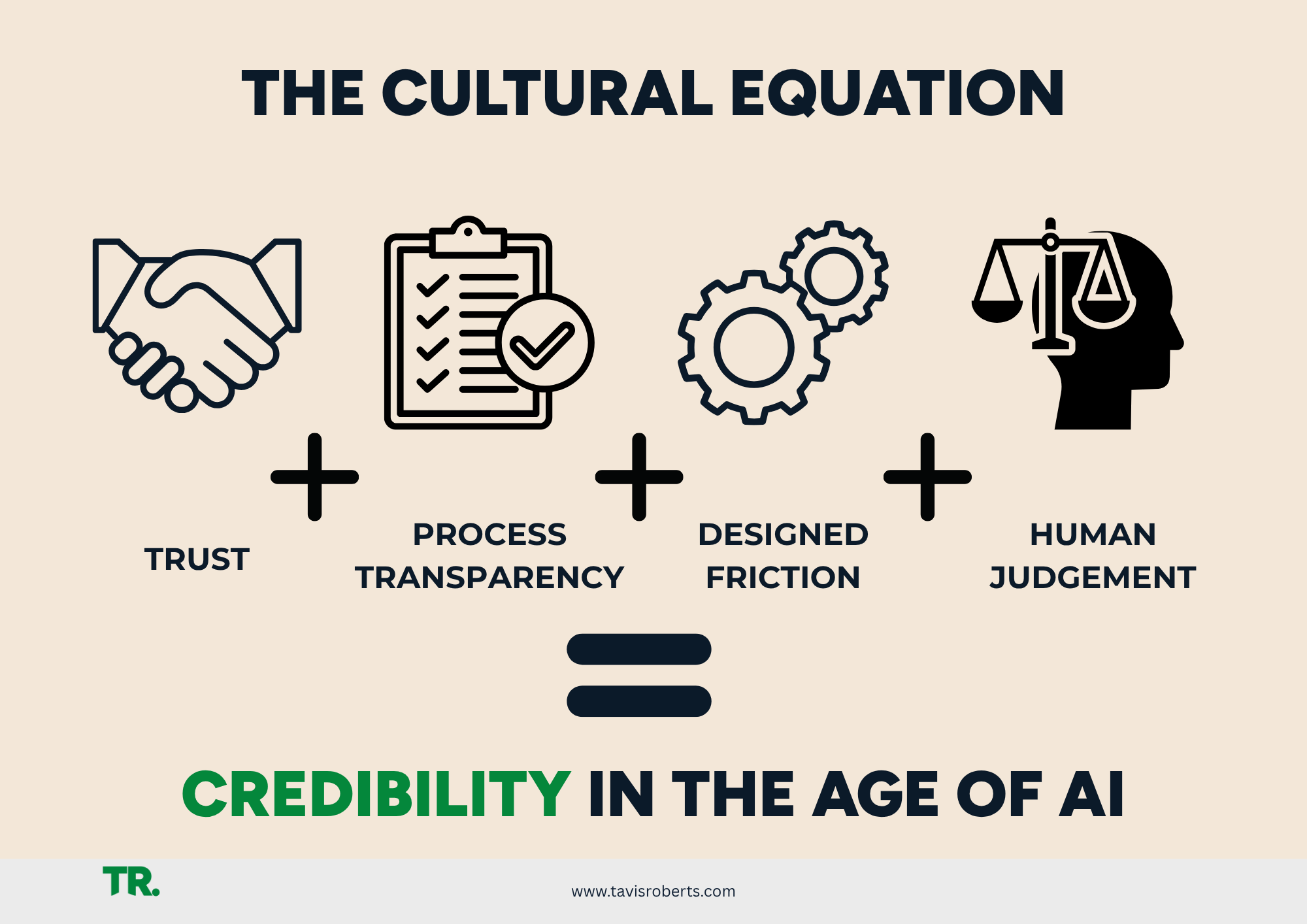
Together, these conditions shift education from artifact-policing to reasoning-verification.
They transform AI from a shortcut into a scaffold—something that strengthens learning rather than devaluing it.
This is the proposed credibility equation: not proof through polish, but proof through process.
The Talk, Revisited
We began with The Talk—that uneasy moment before an honest conversation.
We are still standing in that pause. The world has already changed; what comes next depends on whether we can face that change together.
The purpose of The Talk was never comfort—it was preparation. It was the act of stepping forward with trust, even when certainty isn’t possible. The same is true for education now. We cannot return to the silence of secrecy or the safety of control. We have to create the conditions where trust, transparency, and curiosity can coexist with technology—where learning remains both human and adaptive.
This is our work as educators: to move forward with purpose and courage, ready to meet the challenges that the world will continue to pose to us.
Because the purpose of education was never to prove that learning happened.
It was to make the process of learning worth seeing.