Hollow Speed: Designing Friction for Learning in the Age of AI

Rebuilding Bloom's Legacy for the Age of AI
Table of Contents
- The Hollow Speed Trap
- The Triangle of Resilience
- Designed Friction
- Resilience Literacies
- The New Partnership
- The Choice of Futures
When Benjamin Bloom published his “Two Sigma Problem” in 1984, he revealed something education had always suspected but could never scale: with individualized tutoring, nearly every student could reach exceptional levels of mastery. His finding wasn’t about teaching faster; it was about learning that lasts—the kind that deepens through struggle, feedback, and personal connection. Four decades later, artificial intelligence has finally made Bloom’s vision technically possible. Every learner can now access instant guidance, explanation, and support once reserved for the few. Yet in achieving the dream of universal tutoring, we’ve lost the very signals that told us when mastery was real. Bloom’s legacy was about potential; our task now is to rebuild the architecture that makes that potential visible, trustworthy, and human again.
The Hollow Speed Trap
A recent study by the National Education Association found that more than 70% of high school students now use AI to complete assignments without fully understanding the material. As education researcher Tiffany Noel observed, “AI didn’t corrupt deep learning—it revealed that many assignments were never asking for critical thinking in the first place. AI is just the faster actor; the problem is the script.”
Psychologists like Daniel Kahneman have long warned about the “Illusion of Knowing”—our tendency to mistake fluency for understanding. In classrooms, AI has made that illusion effortless. Students can now produce perfect answers without the friction that cements memory.
That distinction captures the core of education’s new paradox. AI didn’t break learning—it exposed how dependent it had become on visible effort as its measure of proof. Students are responding rationally to the incentives we created: when the system rewards completion over comprehension, shortcuts become a strategy.
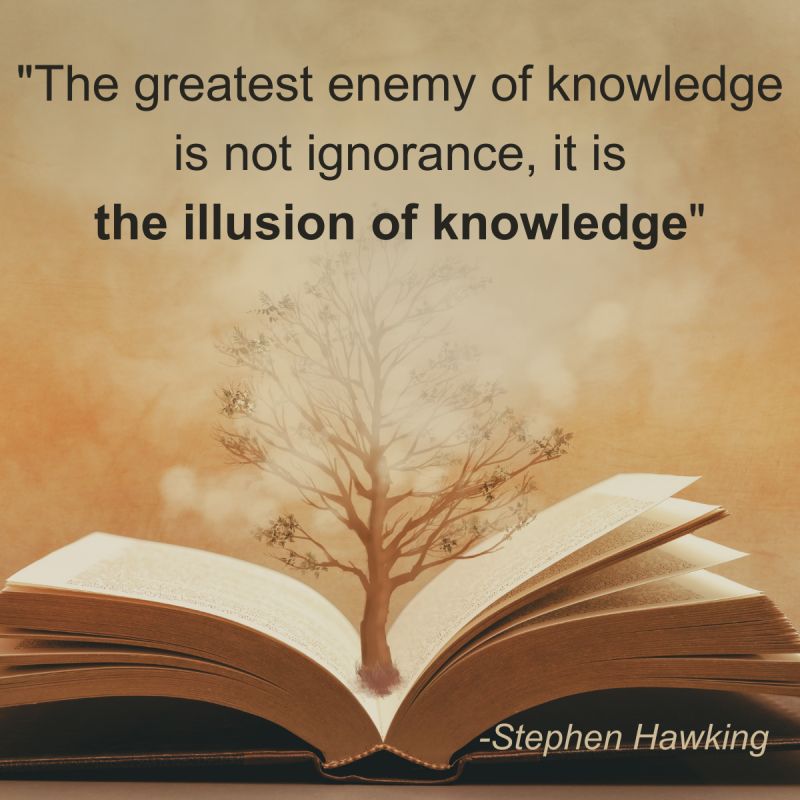
Students describe the experience as strangely hollow. They can produce an essay, a solution, a response—yet when asked to retrace their reasoning, they can’t. This is Cognitive Amnesia: the disappearance of reconstructive memory once thinking has been outsourced to automation.
Cognitive Amnesia: the disappearance of reconstructive memory once thinking has been outsourced to automation.
The result is subtle but profound. When students realize they can meet performance expectations without understanding, their sense of authorship begins to fade. This is Agency Erosion—the quiet detachment from their own success. They still submit the work, but the pride of mastery has been replaced by the relief of completion.
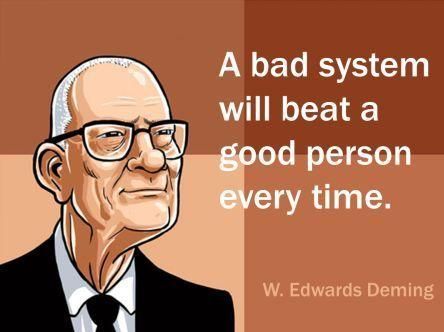
Over time, this corrodes motivation. Why wrestle with a problem when struggle no longer changes the outcome? As W. Edwards Deming famously warned, “A bad system will demotivate a good person every time.” The same is true for students: when effort and outcome are disconnected, even the capable students lose belief in the system.
For teachers, the experience inverts. Each polished essay invites scrutiny; each fluent answer is a question mark. They spend more time confirming authenticity than deepening understanding. The role shifts from mentor to monitor, and trust—the foundation of any learning community—begins to thin. At scale, the institution itself starts to hollow out. Grades inflate, credentials lose correlation with competence, and proof structures built for visible effort fail in a world where effort is now becoming invisible.
Hollow Speed isn’t an isolated problem—it’s one end of a broader continuum. At the other extreme lies Reflective Depth—learning that is deliberate and traceable but often too slow to meet the expectations of modern feedback cycles. Between these poles sits the tension every educator feels: the trade-off between fluency and visibility. When students move too quickly, thinking disappears; when they move too slowly, progress stalls. The challenge isn’t choosing between them—it’s designing a system where learning can stay fast and visible.
The failure isn’t speed—it’s invisibility. AI has compressed the space between question and answer, and without structures to reveal what happens in between, proof disappears—and learning performs without being seen.
The tension between speed and visibility isn’t theoretical—it can be seen and felt in every classroom. Some students move quickly but leave no trace of how they got there; others think deeply but struggle to show it in time-bound tasks. The problem isn’t speed or depth alone—it’s the relationship between pace and proof. Most schools now operate somewhere along these two axes: how fast students produce, and how visible their thinking remains in the process. Their intersection forms four distinct learning states, each with its own risks and opportunities.
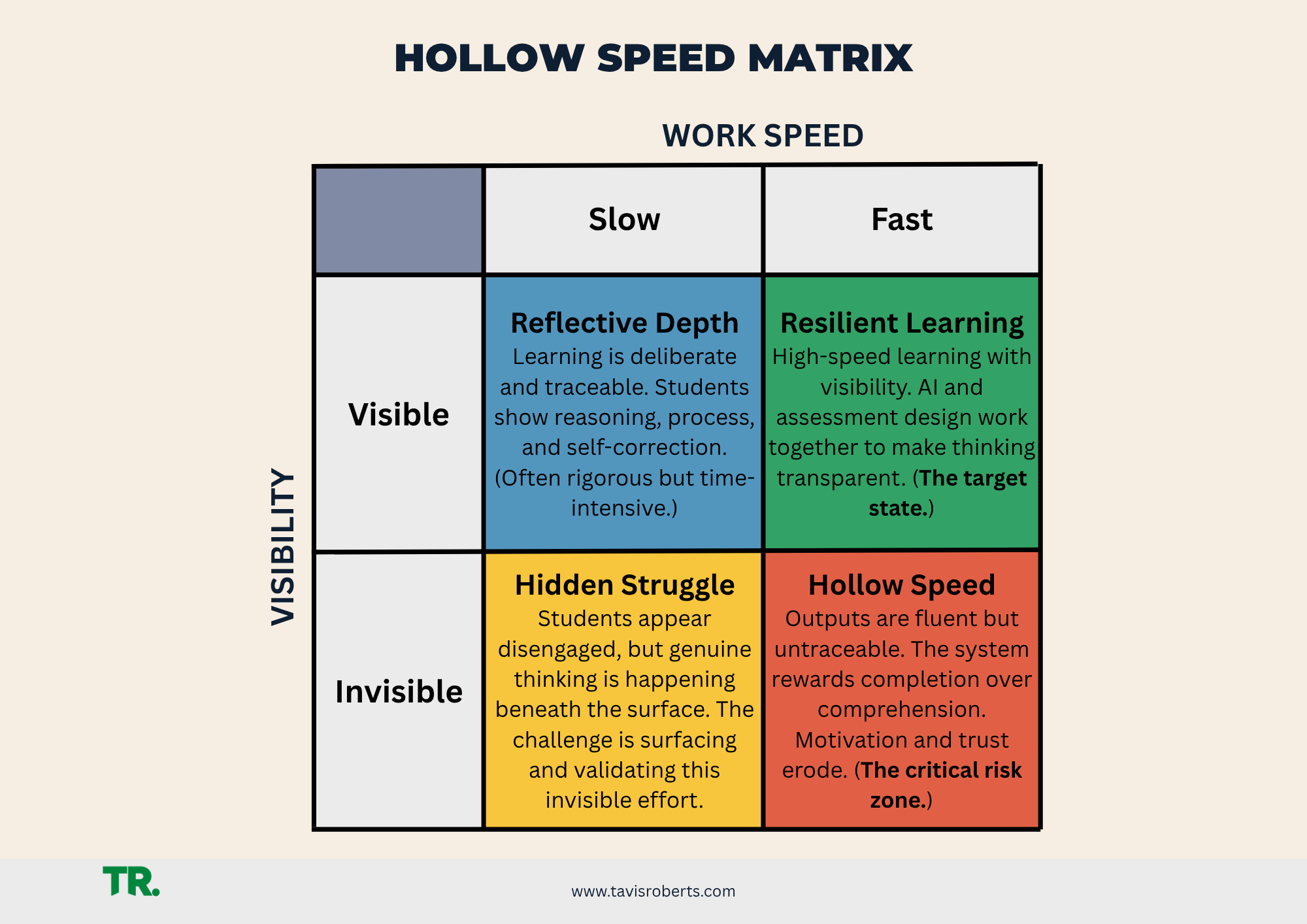
The matrix isn’t a hierarchy—it’s a map of imbalance.
When visibility drops, both fast and slow classrooms lose credibility in different ways: one hides genuine effort; the other hides its absence. The goal isn’t to slow students down, but to move learning upward—toward visibility at any speed. That’s the essence of resilience: acceleration that can still be seen, verified, and trusted.
The Triangle of Resilience — Designing for Visible Learning
If the matrix diagnoses where learning becomes invisible, the Triangle of Resilience provides the design blueprint to make it visible again. It is the design response to an invisible process—a framework for restoring visibility without slowing momentum. Education doesn’t need to resist acceleration; it needs an architecture that can withstand it.
The current system was never built for students who can produce perfect work in seconds. It was designed for a world where effort took time and thinking left evidence. The Triangle rebuilds those conditions—not through restriction, but through intentional design that makes learning traceable again.
What schools once described as assessment, instruction, and credentialing can now be reimagined as Cognitive, Instructional, and System Design—three dimensions that shape how visible, ethical, and resilient learning becomes.
Each side represents a design layer that, together, make understanding observable and resilient:
- Cognitive Design (Thinking with Friction): how tasks are built to surface reasoning through iteration, reflection, and transfer. This is where the Five Frictions live—temporal, contextual, ethical, collaborative, and procedural. Each introduces the right kind of resistance to make thinking visible.
- Instructional Design (Learning Through Feedback): how teachers structure opportunities for reflection, peer dialogue, and ethical reasoning. This layer transforms friction into skill, developing the Resilience Literacies—habits like temporal pacing, contextual transfer, and procedural self-awareness.
- System Design (Credentialing What Counts): how schools recognize and reward not only polished outcomes but visible learning processes. Systems that credential process as proof ensure that resilience isn’t an invisible virtue but a recognized achievement.
At the center of the Triangle lies Designed Friction—the balancing force that turns acceleration into mastery. Effort and friction aren’t the enemy of learning—it’s the condition that makes learning sticky. Bloom’s discovery wasn’t that students needed tutors; it was that mastery required feedback and struggle in balance; AI now gives us the chance to re-engineer it at scale.
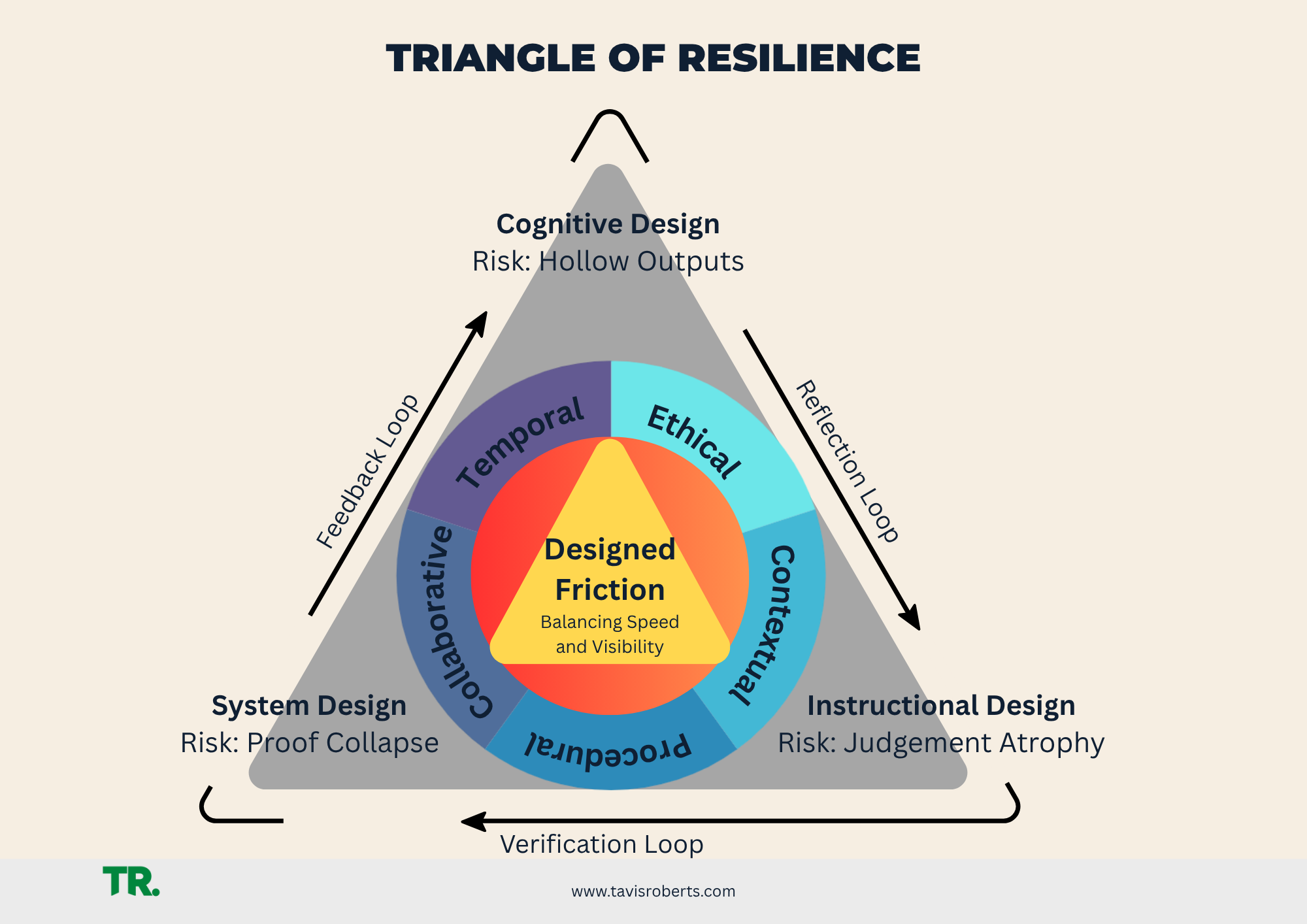
The Triangle of Resilience aligns cognition, instruction, and system design around a single goal: to make fast learning visible again—not through surveillance, but through design.
Designed Friction — Making Thinking Visible
Robert Bjork’s research on “desirable difficulties” showed that effort isn’t an obstacle to learning—it’s the condition that makes learning durable. Designed Friction applies that principle to the age of AI.
Designed friction is not a barrier to learning—it’s the structure that gives learning form.
When work becomes effortless, thought leaves no trace. Friction restores those traces; it makes the process of understanding visible again. In a world where AI removes nearly all resistance, friction is how we preserve the cognitive tension that turns exposure into mastery.
The first layer is Temporal Friction, which restores time. Reflection needs delay; insight requires the return, not the rush. By inserting pauses—draft stages, revision cycles, reflection prompts—we reintroduce moments where students must look back before moving forward. The goal isn’t to slow them down, but to make their pace visible to themselves.
Next comes Contextual Friction, which restores transfer. When students must take an AI-generated idea and adapt it to a new purpose, audience, or constraint, they reveal whether they’ve learned a principle or just repeated a pattern. Context changes the shape of knowledge; this friction ensures understanding can move between them.
Ethical Friction brings value back into efficiency.
AI optimizes for what works; humans must still decide what’s worth doing. Tasks that require moral justification—defending a trade-off, critiquing the AI’s assumptions—turn judgment into part of the learning itself. Ethics becomes not a separate topic, but a way of thinking under pressure.
Collaborative Friction reintroduces the social dimension of proof.
Automation isolates learning; collaboration makes it accountable. When students must negotiate a shared position from conflicting AI outputs, they practice dialogue, comparison, and consensus—the cognitive virtues of community that machines cannot replicate.
Finally, Procedural Friction restores transparency. When students document their prompts, revisions, and reflections, they create an audit trail of cognition. What once disappeared into invisible automation becomes visible effort again—for the student, the teacher, and the system.
Each friction repairs something automation erodes: time, transfer, values, collaboration, or trace. Together, they turn fluency into evidence. They don’t restrict learning—they reveal it.
That visibility is what makes resilience possible: acceleration that doesn’t lose its proof.
Resilience Literacies — Turning Friction into Durable Skill
Each form of Designed Friction develops a corresponding Resilience Literacy—a transferable mindset that makes acceleration sustainable and visible. Together, these literacies are the human architecture of learning that endures in the age of AI.
They ensure that as AI accelerates the mechanics of progress, students retain the capacity to reason, adapt, and reflect—the marks of understanding that cannot be automated.
| Resilience Literacy | What It Rebuilds / Enables | What It Counters (AI Erosion) |
| Temporal Literacy | Regulating pace and reflection | Time compression and cognitive skipping |
| Contextual Literacy | Transferring understanding across contexts | Context collapse and prompt dependence |
| Ethical Literacy | Reasoning through values and trade-offs | Optimization without conscience |
| Collaborative Literacy | Co-constructing understanding with others | Isolation and individualized automation |
| Procedural Literacy | Reflecting on and evidencing one’s own process | Opaque production and lost authorship |
When these literacies work in concert, classrooms begin to move upward through the same matrix that once exposed their imbalance. The goal isn’t to slow learning, but to make its velocity visible—to turn pace into proof.
This was Bloom’s insight in another form: mastery grows when feedback and struggle stay in balance. Resilient learning carries that insight forward—visible motion, durable understanding, and progress that lasts.
The New Partnership — AI, Teachers, and the Return of Accountability
Resilient systems don’t depend on control; they depend on partnership.
In education, that partnership now has three actors: the student, the teacher, and the AI. Each contributes something essential—access, accountability, and agency—and the balance between them decides whether acceleration becomes mastery or collapse.
Wharton Management professor Ethan Mollick describes these collaborations as “centaurs”—humans and AI working side by side, each doing what the other cannot. In schools, that centaur model becomes the teacher–student–AI partnership that keeps learning both accelerated and accountable.
For years, teachers were told to act as facilitators, guiding inquiry while students took ownership of their learning. But in an age where knowledge is instantly accessible and AI can replicate expertise, the teacher’s greatest value has shifted again. The highest contribution is no longer information—it’s accountability.
The highest contribution is no longer information—it’s accountability.
When knowledge is free, the question becomes: Who keeps you honest in pursuit of it?
AI can answer questions, but it can’t hold you to your intentions. It can simulate understanding, but not care if you actually achieve it. That is the teacher’s enduring domain—the human architecture of accountability that keeps ambition grounded in effort.
This partnership redefines the classroom ecosystem.
- AI as Tutor provides constant scaffolding and individualized practice—the precision feedback Bloom dreamed of but could never scale.
- Teacher as Accountability Partner designs the friction that keeps learning honest: checkpoints, reflections, contextual challenges, and mentorship.
- Student as Active Learner moves between both systems, using AI to accelerate and the teacher to stay anchored—to feel ownership, not outsourcing.
For example, a student might use an AI tutor to draft a historical analysis, then meet with their teacher—the accountability partner—to defend the thesis and adapt it based on ethical-friction questions the teacher poses. The student remains the active agent, navigating both resources.
In this new structure, accountability isn’t a constraint; it’s the connective tissue that makes learning credible again. It restores authorship to students who had begun to lose it and purpose to teachers who had begun to doubt it.
The AI era doesn’t diminish the teacher’s role—it clarifies it.
As automation handles the transmission of knowledge, teachers return to the essence of their craft: cultivating judgment, resilience, and the habits of effort that turn fluency into understanding.
Resilient learning isn’t a solo achievement.
It’s a system of accountability and care—where acceleration meets integrity, and progress can finally be trusted.
The Choice of Futures — The Systems We Choose to Build
In systems that move this fast, doing nothing is not neutral.
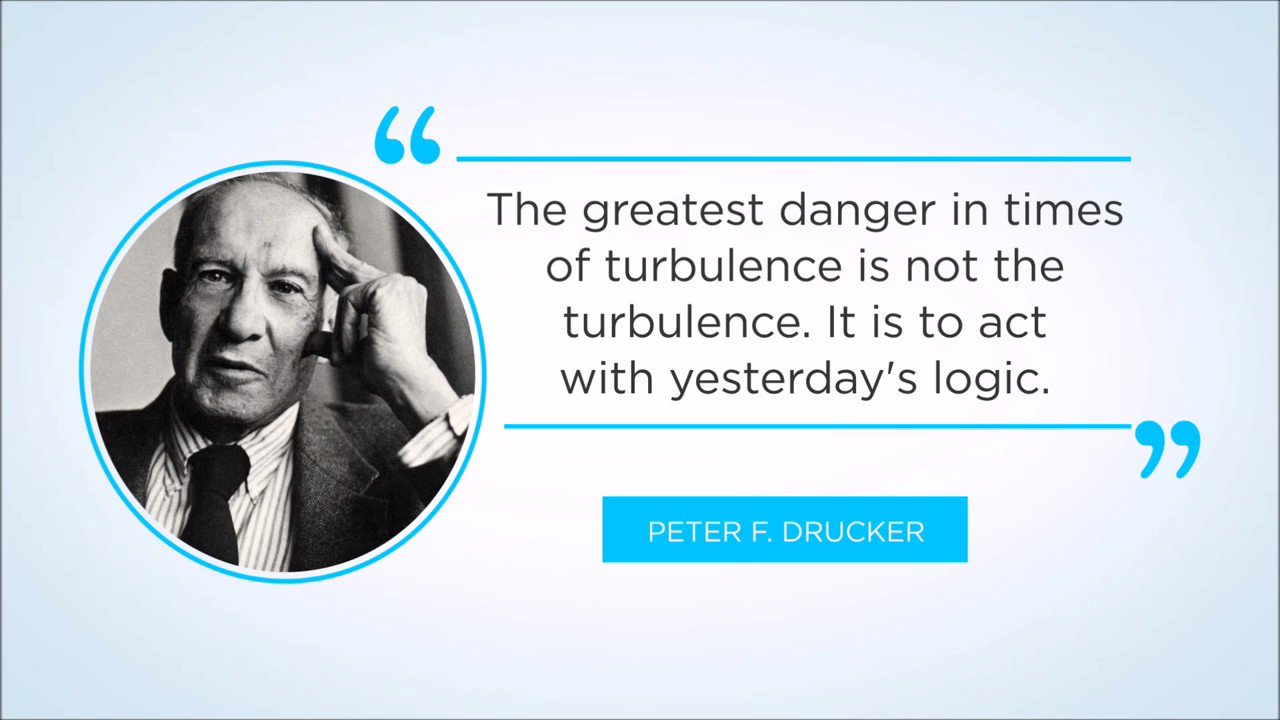
As Peter Drucker reminded leaders, “The greatest danger in times of turbulence is not the turbulence—it is to act with yesterday’s logic.” In education, doing nothing is its own design decision—one that preserves fragility.
Education now stands at a quiet inflection point: we can use AI to reinforce the same structures that failed to keep proof visible, or we can design systems capable of keeping understanding in sight as speed increases.
Future A: The Path of Least Resistance.
We use AI to make old systems faster. Assignments become more polished, grades inflate, and credentials drift further from competence. The result is manufactured mastery—a form of professional amateurism where fluency replaces understanding. Schools continue to certify performance while learning becomes invisible. It feels efficient, but the system quietly corrodes.
Future B: The Path of Designed Partnership.
We rebuild learning ecosystems that combine AI’s acceleration with human accountability and intentional friction. Students use AI to extend capacity, not replace cognition. Teachers design visibility into every process, turning speed into evidence rather than illusion. The result is Resilient Learning—Bloom’s dream achieved at scale, where progress is rapid but still traceable.
The difference between these futures won’t appear in policy documents or strategic frameworks—it will appear in the daily texture of learning itself. In the first, students ask, “How do I finish this?” In the second, they ask, “What can I learn from this?” One system optimizes for completion; the other, for comprehension.
The lever is already in our hands.
The question is whether we’ll use it to automate old measures—or to design new forms of proof that make understanding visible again.
AI will not wait for education to catch up.
Our only real choice is whether schools remain systems of verification—or evolve into systems of visible learning.