The Two Disruptions: How AI Will Transform Education Twice in a Decade
 From judgment to integration, education must reinvent the currencies of proof.
The Collapse of Proof
Proof of learning in the age of AI is under pressure. Essays, reports, even polished presentations that once served as signals of knowledge are being are losing their trust and credibilitiy. The kind of work that once required hours of study and practice can now be generated in minutes.
That leaves education facing a harder question than plagiarism or cheating: if output is free, what is academic proof worth?
The word “proof” carries two meanings. One is internal: the evidence of learning within the student; the growth of knowledge, skill, and mental models. The other is external: the socially recognized currency that others can trust. These are the costly signals of competence embedded in tests, essays, and credentials.
AI dismantles the second without touching the first. Students may still be learning, but the signals that once demonstrated it no longer carry the same weight.
For centuries, those signals relied on cost. An essay proved more than writing ability; it showed that a student had read, drafted, refined, and endured the process. The effort made the output credible.
Now the effort can be bypassed. The work remains, but the struggle is gone. And without the struggle, the proof collapses.
This collapse of trust isn't an accident; it's the direct, unintended consequence of two systems that are misaligned. As I explored in "Why Schools and AI Are Locked in a War Nobody Wanted", the fundamental economics of how we validate learning are breaking down. AI hasn't just changed how we produce work, it has broken the fragile currency schools have long relied on to prove that learning has occurred.
Proof Has Always Evolved
The collapse of proof is not unique to the age of AI. Every time humans found a new way to learn, we also had to discover new ways to prove it.
| Stage of Learning | Source of Knowledge | Nature of Experience | Example | Currency of Proof | Key Risk |
| Experiential (Early Human Learning) | Self | Actual | Touching a hot stove; learning to ride a bike | Survival and adaptation: Did you live, or did you master the skill through trial and error? | Injury, wasted effort, failure |
| Visualization / Mental Rehearsal | Self | Imagined | An athlete visualizing a routine; a student rehearsing math steps mentally | Foresight and planning: Can you anticipate and prepare before acting? | Faulty planning, repeated errors |
| Observational - Classroom Models, Apprenticeship | Others | Actual | Watching a teacher solve an equation and copying it; learning craft skills through imitation | Replication: Can you accurately reproduce what you see? | Shallow copying without deeper understanding |
| Narrative - Stories, Texts, Case Studies | Others | Imagined | Drawing business lessons from literature; analyzing a case study in class | Interpretation: Can you extract meaning and apply it in context? | Myths or misinformation hardening into dogma |
| AI-Augmented (Present) | Machine (Synthetic outputs) | Generated, but directed by humans | Using AI to draft a business plan, then revising critically | Judgment and orchestration: Can you interrogate, evaluate, and refine machine output? | Hollow outputs, overreliance, surface-level competence |
| AI-Generative (Emerging) | Machine (Autonomous discoveries) | Generated, with limited human input | AI discovering a new protein structure; proposing novel theorems | Interpretation and integration: Can you translate and embed machine discoveries into human systems? | Drawing lessons from literature, analyzing a case study in class |
Proof began with physical experience: mastery was demonstrated through action, such as learning to ride a bike by falling or avoiding a fire after being burned. From this foundation, proof evolved inward, toward mental rehearsal and the ability to simulate outcomes before acting, much like a student working through a math problem in their head, which signaled learning by anticipating the next step before taking it.
The next leap moved learning from the individual to the group. Proof became replication. Watching a master craftsman or a teacher, then imitating their technique, showed that you could follow and repeat what you had seen. From there, proof took on a narrative form. Through stories, literature, and case studies, learners demonstrated interpretation, the ability to extract meaning, and apply it to their own context.
The pattern is clear. Each stage made the previous proof less decisive, not because it disappeared, but because abundance weakened its signaling power. Apprenticeships spread, and replication no longer sets you apart. Literacy became common, and interpretation lost its scarcity. Mass schooling scaled, and essays turned from costly signals into routine expectations. Proof has always evolved in response to abundance.
Now comes AI. And AI enters this lineage not once, but twice, first, as a tool that produces outputs cheaply, forcing proof to shift to judgment and orchestration. And soon, as a system capable of generating discoveries on its own, it will demand that proof shift again to interpretation and integration.
What once took centuries is now being compressed into a single decade.
Two Disruptions, Not One
The charts point to an uncomfortable truth. AI does not disrupt education once, but twice.
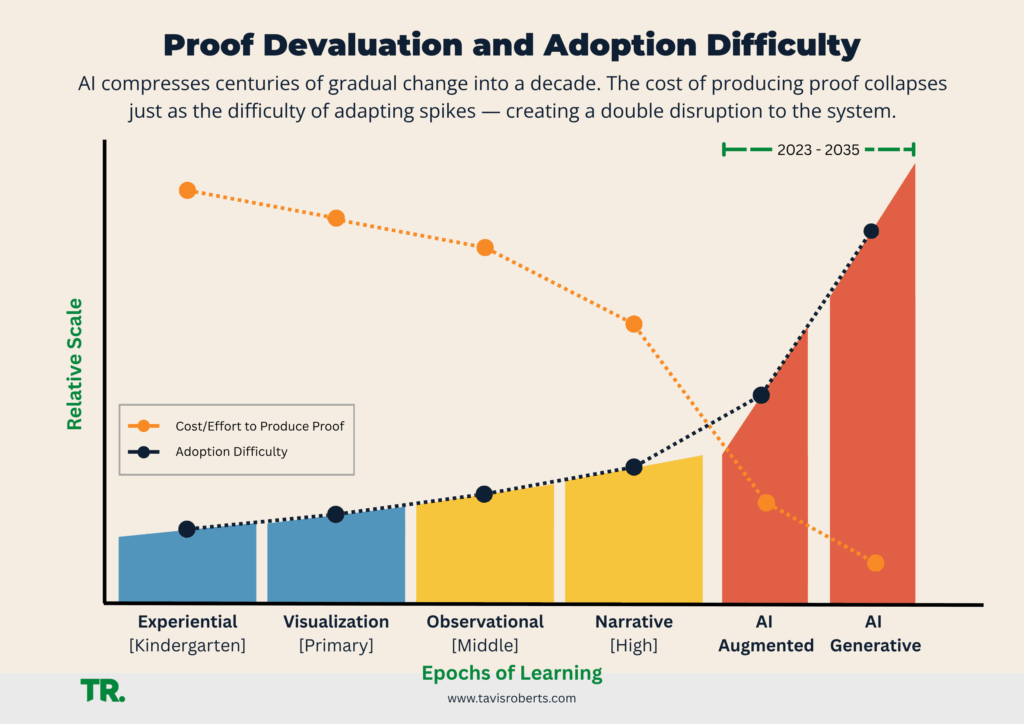
What once unfolded across centuries, and across a student's entire educational journey, is now collapsing into a single decade.
A kindergartener's experiential learning develops into a primary student's visualization, then a middle-schooler's imitation, and finally a high school and university student's narrative interpretation. This progression mirrors humanity's own path: from survival to storytelling. AI arrives at the peak of both arcs simultaneously. It compresses this gradual ascent into a vertical cliff, devaluing the very proofs of imitation and interpretation that students spend years mastering and that society has long trusted.
The first disruption is already here. Call it the Augmenting Crisis. Output has become abundant. Essays, reports, and polished answers no longer serve as reliable proof. The task of learners is shifting from producing work to judging and orchestrating what AI produces.
The second disruption is close behind. Call it the Generating Crisis. If AI begins to make discoveries of its own; new equations, theorems, or policy designs, then even judgment will be diminished. Proof will have to move again, toward interpretation and integration. Learners will not only need to evaluate what AI generates, but also to embed it within human systems in ways that are ethical and meaningful.
The danger is not simply the pace of change. It is the temptation to believe we can adapt once and be done. The greater error would be to build for the first disruption, only to be blindsided by the second.
History offers a warning here. Every stage of learning has inflated away the value of the proofs that came before it. Apprenticeships made replication cheap. Literacy made interpretation cheap. Mass schooling made the essay cheap.
AI accelerates the pattern. It is hyperinflation. Imitation and interpretation collapse at the same time, leaving us with a glut of outputs that look credible but carry little value. In such a system, everyone appears rich in work but bankrupt in trust.
What’s Required Now
These two disruptions are not distant speculation. They define what it means to learn, and to prove learning, today.
AI-Specific Currencies of Proof and Required Skills
| Stage of Learning | Currency of Proof | Required Skills |
| AI-Augmented (Present) | Judgment and Orchestration: Can you interrogate, evaluate, and refine AI output? | Interrogation IQ — asking sharper, more targeted questions to push AI beyond surface answers. Judgment Latency — spotting flaws, biases, or inaccuracies quickly. Synthesis Signature — leaving a human fingerprint by connecting ideas in ways AI cannot (e.g., linking theories through personal experience or metaphor). Ethical Load-bearing — navigating value trade-offs AI cannot resolve |
| AI-Generative (Emerging) | Interpretation and Integration: Can you translate and embed AI discoveries into human systems and procedures? | Interrogation IQ — asking sharper, more targeted questions to push AI beyond surface answers. Judgment Latency — spotting flaws, biases, or inaccuracies quickly. Synthesis Signature — leaving a human fingerprint by connecting ideas in ways AI cannot (e.g., linking theories through personal experience or metaphor). Ethical Load-bearing — navigating value trade-offs AI cannot resolve |
For the Augmenting Crisis, proof shifts from what you know to how you judge. This is why knowledge is not obsolete, but its purpose has transformed. It is no longer the final product to be displayed, but the essential foundation for judgment.
Without a baseline of understanding, a learner cannot interrogate AI or catch its flaws. They cannot spot a subtle error in reasoning if they lack the reasoning to begin with. As the Nobel laureate Herbert Simon once wrote, “A wealth of information creates a poverty of attention.” AI creates that wealth. When answers are free, the scarce resource becomes the knowledge-based ability to evaluate them.
"A wealth of information creates a poverty of attention.”
- Herbert Simon (Noblel Laureate)
Knowledge remains the foundation of proof because it gives shape to judgment. An AI can deliver information, but it cannot provide the mental models that allow humans to weigh, question, and apply that information. Without those models, the learner becomes a passive consumer of outputs, unable to separate the useful from the hollow.
The essential skills for this new currency of proof are:
- Interrogation IQ: the ability to ask sharper, more targeted questions that push AI beyond surface-level answers.
- Judgment Latency: the speed with which you can spot flaws, biases, or inaccuracies before they spread.
- Synthesis Signature: leaving a recognizable human fingerprint in the way ideas are joined. For example, an AI can summarize two theories, but only a human can connect them through a personal story or a metaphor, creating a new, signed insight.
- Ethical Load-bearing: the capacity to hold space for competing values. For example, justice versus mercy, fairness versus efficiency. AI can generate plausible paths for both and can reason that both are right.
For the Generating Crisis, proof will shift again, from how you judge to how you integrate. This demands a different set of skills:
- Interpretation Literacy: making machine discoveries legible for human audiences.
- Contextualization: placing AI’s outputs within the right cultural, historical, or disciplinary frame.
- Ethical Integration: deciding not only if AI’s outputs are correct, but whether they should be applied at all.
- Collaborative Governance: sharing responsibility with both AI and people in shaping decisions that cannot be left to either alone.
Research Spotlight: When Proof Itself Is Exposed
Research by economists Ed Felten, Manav Raj, and Rob Seamans (March 2023) reveals a startling fact: the occupations most exposed to AI are highly educated roles like Teachers and Professors.
This is the Augmenting Crisis in data form. The core skills of these roles, explaining, teaching, and writing, are precisely what current AI excels at. Their "proof" of knowledge and expertise has been hollowed out.
The finding underscores a brutal truth: if even a professor's outputs are no longer a reliable signal, then proof must migrate from producing knowledge to orchestrating and judging it; the foundational skills of the next currency of proof.
These skills fall on two time horizons. In the next five years, orchestration will be the test of credibility. In the following decade, integration will become just as critical.
Proof, in other words, must evolve twice — in rapid succession.
Why New Currencies Matter
AI hasn’t just changed how we learn - it has saturated the assessments of proof with polished work at near-zero effort.
The reason is abundance. Every new stage of learning eventually produced more of the old proofs than the system could value. What was once scarce became widespread, and its power as a signal weakened.
AI accelerates this pattern to an extreme. It has demolished the cost of outputs so completely that imitation and interpretation, the twin pillars of academic proof for centuries, are being devalued at the same time. The familiar currencies of schooling, the essay, the project, and the assignment no longer carry the weight they once did.
The result is not just devaluation, but a state of overwhelming abundance. We are flooded with competent, polished outputs. But as the volume grows, the meaning attached to any single piece of work diminishes.
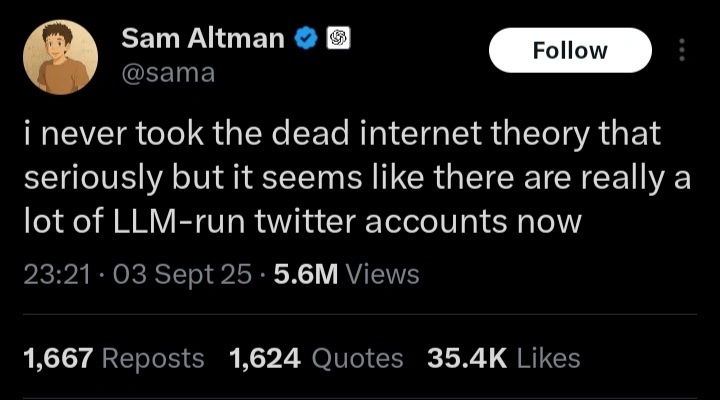
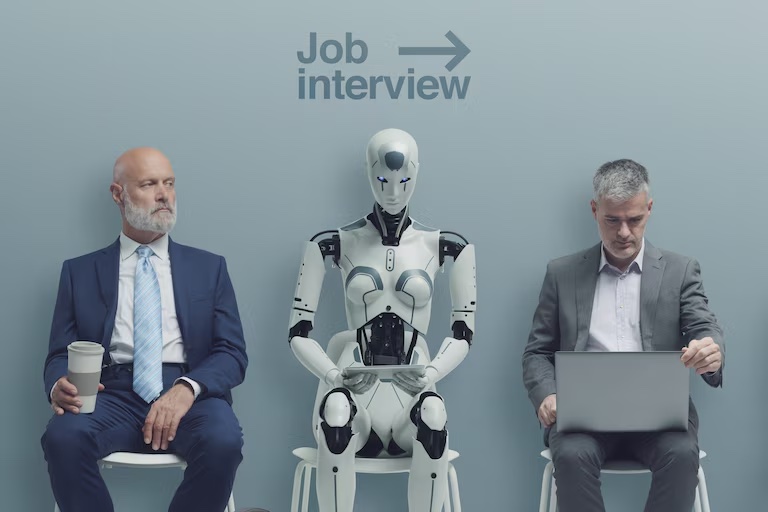
This is the core shift: from an economy of scarcity to an economy of abundance. In this new economy, what is scarce is no longer the ability to generate content, but the ability to create work that is genuinely meaningful, original, and context-rich. It is the difference between one minute of pure, insightful value and one hundred minutes of repetitive AI-generated information. The former cuts through the noise; the latter adds to it.
This is why new currencies of proof are essential. They must be rooted in what AI cannot mass-produce: discernment, originality, and the capacity to place knowledge in context. Without them, abundance will not enrich learning, it will drown it.
The Devaluation of Human Expertise
The challenge for education is not preparing for one AI disruption, but for two overlapping futures.
The first is the Augmenting Crisis, where outputs become cheap and proof shifts to judgment and orchestration. The second is the Generating Crisis, where discoveries themselves become abundant and proof must shift again to interpretation and integration.
One demands skills of orchestration. The other demands skills of integration. Both will arrive faster than education is used to moving.
If we fail to anticipate both, students may graduate fluent in tools but bankrupt in foundational knowledge and trust. And if we continue to rely on proofs that AI can produce at scale, we risk making human expertise the scarcest resource of all, one that our systems of proof no longer know how to value.