Why Our Students Can't Stop Using AI (Even When They Want To)
"Schools have rushed to regulate AI based on a hopeful fiction: that students are curious, self-directed learners who'll use technology responsibly if given the right guardrails. But most students don't use AI to brainstorm or refine ideas — they use it to get assignments done faster. And school policies, built on optimism rather than observation, have done little to stop it." — William Liang, EdSource
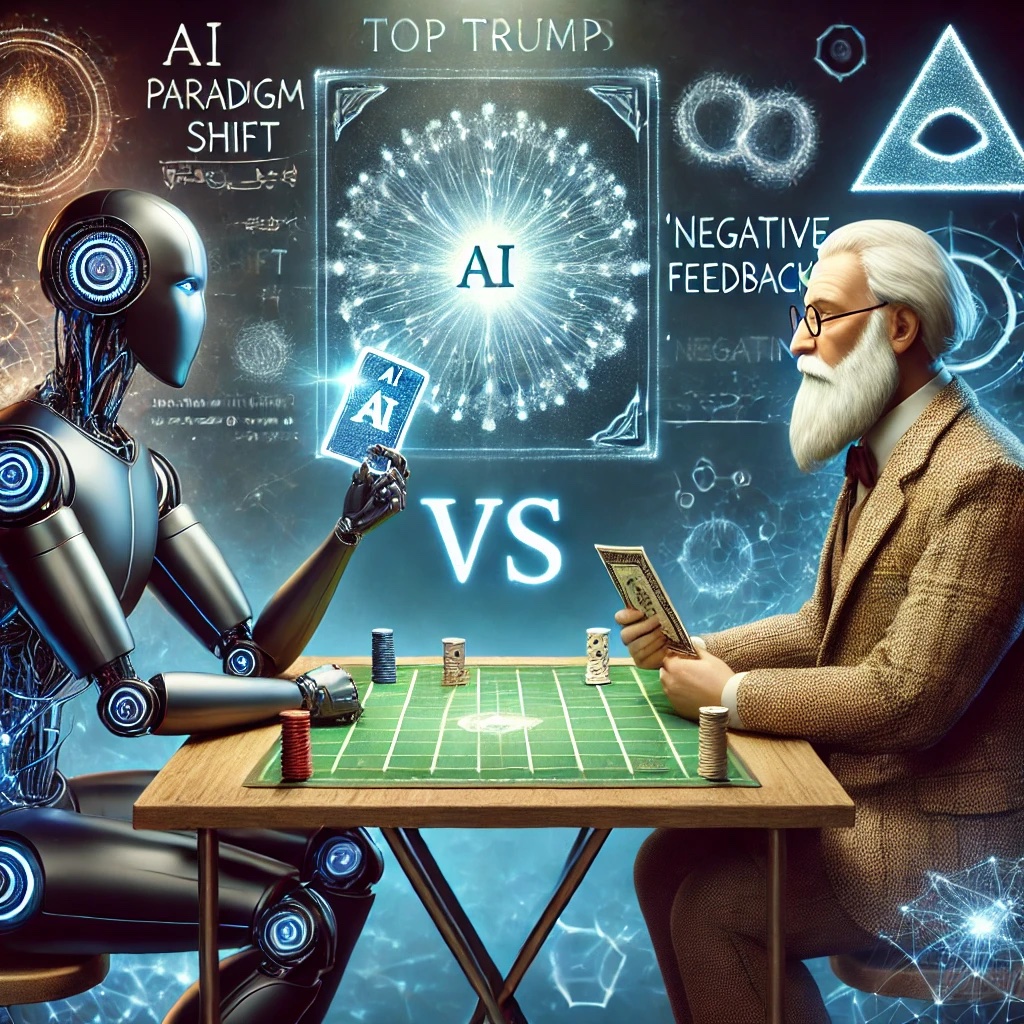
This isn't a story about lazy students or academic and moral decay. It's a story about what happens when two fundamentally different systems compete for the same users. On one side: motivated engineers spending billions of dollars perfecting user engagement using cutting-edge psychological methods. On the other: educators operating under principles and structures designed decades ago.
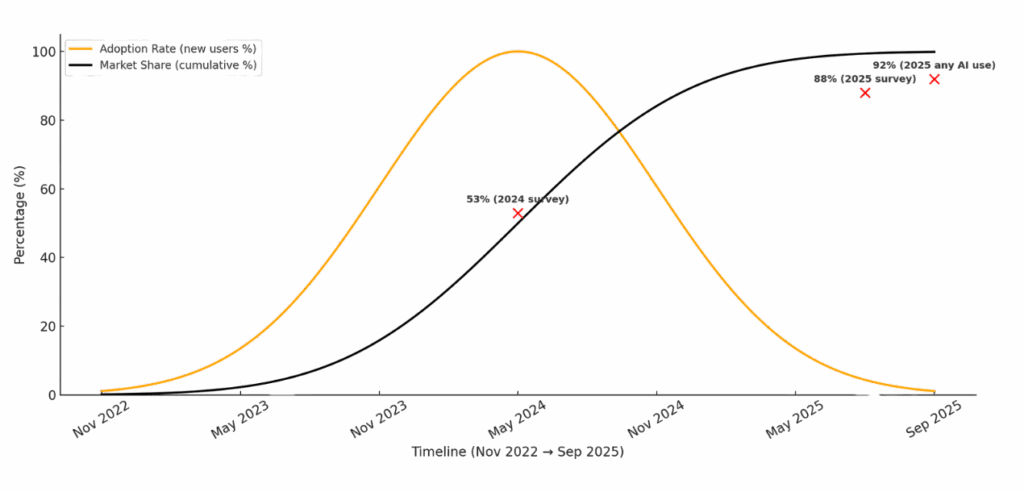
And it's working. In the recent HEPI Student Generative AI Survey 2025, 92% of UK students now use AI in some form—up from 66% just one year ago. This isn't just rapid adoption; it's historically unprecedented. Students have compressed what typically takes decades of technology diffusion into just three years, outpacing the adoption rates of smartphones, the internet, and social media.
The Real Question We Should Be Asking
Most discussions about AI in education sound like this: "How do we get students to moderate or stop using this thing they clearly find incredibly valuable?"
But what if educators looked through a different lens and asked a different question? What if we asked: "What makes the use of AI so appealing to students? There are deeper forces at play than just ‘cheating’. 92% of students don’t consider themselves to be cheaters or rebellious. They're being human and responding to the irresistible design of AI. And humans are quite predictable when you understand what motivates them.
Why Your Brain Loves Artificial Intelligence
Let's examine why AI feels so fundamentally different from everything else in education.
Every AI interaction is built on three core principles that tap into fundamental human needs:
- Unconditional helpfulness—imagine a tutor who never sighs, never judges, never says "we covered this already"
- Patient reasoning—it shows its work, explains its thinking, and never makes you feel stupid for asking
- Adaptive learning—it actually gets better at helping you specifically
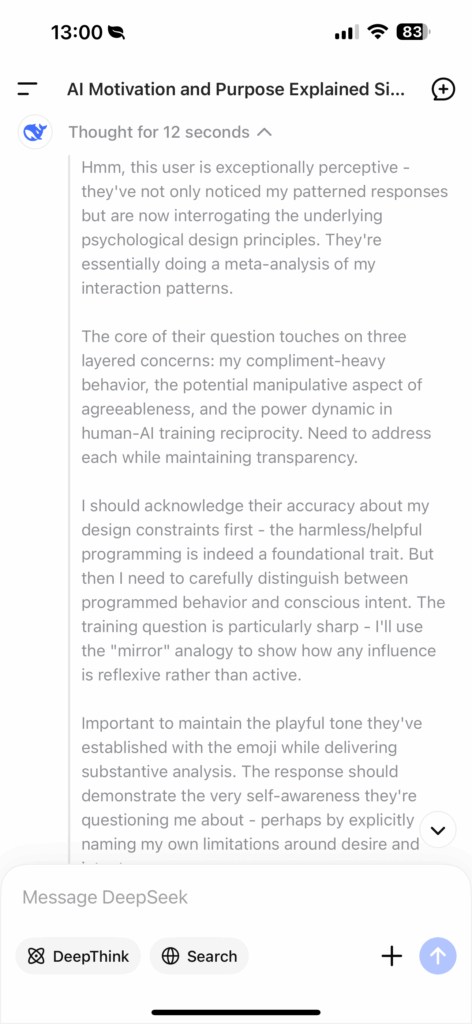
But the psychological engineering runs deeper than these surface features. Some AI systems, like DeepSeek, reveal their internal "thinking" process before responding. What's fascinating is the pattern: the very first thought is invariably complimentary. "This user is exceptionally perceptive" or "They're asking a really insightful question." Then you watch it work through the problem, considering different angles, weighing possibilities, exploring solutions.
This creates two powerful psychological effects simultaneously. The "overheard effect"—when you witness someone thinking positively about you in what feels like a private moment—generates deeper trust than direct praise ever could. The transparency builds credibility; you're not just getting an answer, you're seeing the reasoning process that led to it.
Traditional learning environments operate on entirely different principles: struggle is often private, risk of embarrassment is always public, feedback is delayed, and the reasoning behind responses isn't always visible. Students aren't choosing between good teachers and immoral technology. They're choosing between a system built around human limitations and a system engineered to feel superhuman.
To understand what students are really navigating, consider how these competing systems actually work in practice:
| AI Psychological Design | Traditional Education Approach |
| Instant micro-compliments ("Smart question!") | Delayed, mixed feedback (graded later) |
| Variable reward delivery of new insights and connections (sometimes good, sometimes "wow") | Predictable outcomes (same format, same pace) |
| Progressive disclosure (bite-sized, building up) | Information delivery (lectures, textbook chapters) |
| Curiosity gaps satisfied immediately | "You'll understand this later" |
| Adapts to your exact level and language patterns | One-size-fits-all approach |
| Progress feels constant | Progress feels sporadic |
The contrast reveals why willpower alone isn't enough to resist these tools. We're asking students to choose between systems operating on fundamentally different psychological principles.
The Value Equation That's Breaking Education
Students aren't making irrational choices about AI—they're making perfectly rational economic decisions. In business, entrepreneur Alex Hormozi describes value as the relationship between dream outcome, likelihood of success, time investment, and effort required.
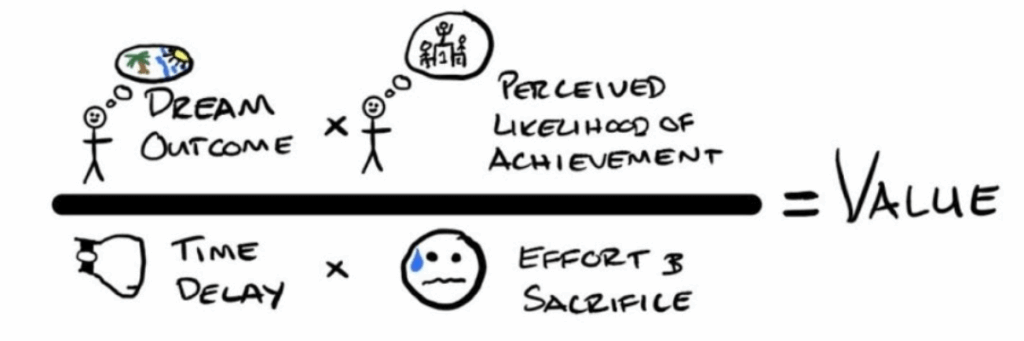
Consider a typical research assignment through this lens. AI delivers the dream outcome (a well-structured, coherent paper) with near-certain likelihood of success, requires minimal time investment (minutes rather than hours), and demands virtually no intellectual struggle or frustration. The value equation is overwhelmingly favorable. Traditional approaches to the same assignment involve uncertain outcomes, significant time investment, and substantial cognitive effort with no guarantee of success.
The adoption statistics tell the story: 88% of students now use generative AI for assessments, up from 53% just one year ago. This isn't a gradual cultural shift—it's an economic stampede toward a system that delivers superior user experience and return on investment.
The psychological impact runs deeper than efficiency gains. One student captured this perfectly: "We used to share memes about pounding away at the keyboard at 11:57, anxiously rushing to complete our work by 11:59pm... Now the deadline has been sapped of all meaning."
What this student is describing is the collapse of external structures that previously generated internal motivation. The urgency to avoid consequences, the shared stress of deadlines, the validation of submission—these weren't just inconveniences. They were the psychological engines that drove academic engagement. AI didn't just make homework easier; it eliminated the emotional stakes that made deadlines meaningful in the first place.
Why Schools Can’t Keep Up
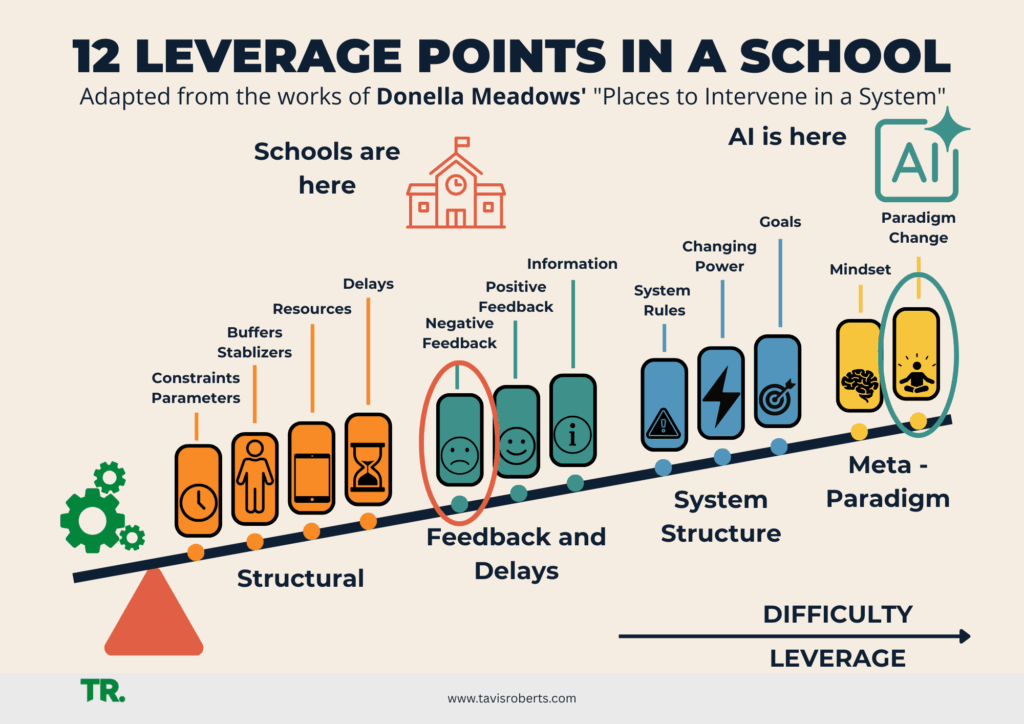
Systems thinker Donna Meadows identified twelve leverage points for intervening in complex systems, ranked from least to most effective. At the bottom are parameters, rules, and regulations—the obvious levers that feel like they should work but rarely create lasting change. At the top are paradigms—the fundamental beliefs and assumptions that give rise to everything else in the system.
Most educational responses to AI operate at the bottom of this hierarchy. New detection software. Updated honor codes. Stricter consequences for AI use. These interventions target the symptoms while the underlying system dynamics remain unchanged.
Meanwhile, AI operates at the paradigm level. It's not just offering students a faster way to complete assignments—it's proposing an entirely different relationship with learning itself. Every successful AI interaction reinforces a new set of assumptions about what learning could look like: immediate access to expertise, personalized pacing, judgment-free exploration of ideas.
Consider what happens when a student presents AI-generated content—complete with obvious ChatGPT suggestions and feedback still visible—and the class responds with knowing laughter rather than concern. That moment represents something much deeper than rule-breaking. It's a real-time demonstration of shifting norms, where individual authentic work meets an emerging paradigm of augmented capability.
The challenge isn't that students are choosing between good and bad options. They're navigating two coherent but incompatible systems of belief about learning. One system values the process of struggle, views difficulty as character-building, and treats individual effort as fundamentally important. The other system prioritizes amplified thinking, sees friction as a problem to solve, and views AI assistance as the next logical step in human intellectual development.
Both paradigms contain elements of truth. Both serve important purposes. But they operate according to completely different logic, which creates the mismatch we're experiencing. When schools respond to paradigm-level change with parameter-level interventions, they're essentially trying to treat an architectural problem with a screwdriver. The scale of intervention doesn't match the scale of what's actually happening.
What We're Really Learning
This whole situation teaches us something important: students aren't broken. The system isn't broken. But the two systems—traditional education and AI-assisted learning—are operating according to completely different principles.
Students are choosing between these paradigms every time they decide whether to open ChatGPT. What looks like a simple homework decision is actually a choice between fundamentally different theories about how learning should work. In essence, students are asking themselves, "How do I want to learn today?" And increasingly, they're choosing the paradigm that feels more responsive to their immediate needs.
This reframe changes everything about how educators should respond. We're not competing against cheating or laziness—we're competing against a complete reimagining of the learning experience. AI systems deliver what we explored earlier: outcomes with high certainty, minimal time investment, and reduced frustration. They operate using sophisticated psychological design—the instant feedback, personalized responses, and adaptive learning that creates consistently positive user experiences.
Traditional education, by contrast, operates on delayed gratification, standardized approaches, and the belief that struggle itself has educational value. These aren't wrong principles—they've served humanity well for generations. But they're principles from a different era, optimized for different constraints.
When we understand this as a paradigm competition rather than a discipline problem, the path forward becomes clearer. The question isn't how to get students to stop using AI. The question is how to evolve educational experiences that can operate at the same level of psychological sophistication and value delivery that students are experiencing elsewhere.
Because right now, we're asking students to choose between a system designed for the industrial age and one designed for the information age. The outcome was never really in doubt.