Bonus: Not All Problems Deserve Equal Effort
The 12 Leverage Points Inside Every School System
Hi there,
Strategy isn't about doing more.
It's about knowing where to apply pressure.
Some leaders fix problems by working harder. Strategic leaders fix problems by finding the highest leverage point in the system and making a small change that creates a big shift.
This is the difference between:
- Sending another reminder vs improving your flow of information.
- Adding another person vs changing the system’s structure.
- Complaining about resistance vs shifting the system’s goal or mindset.
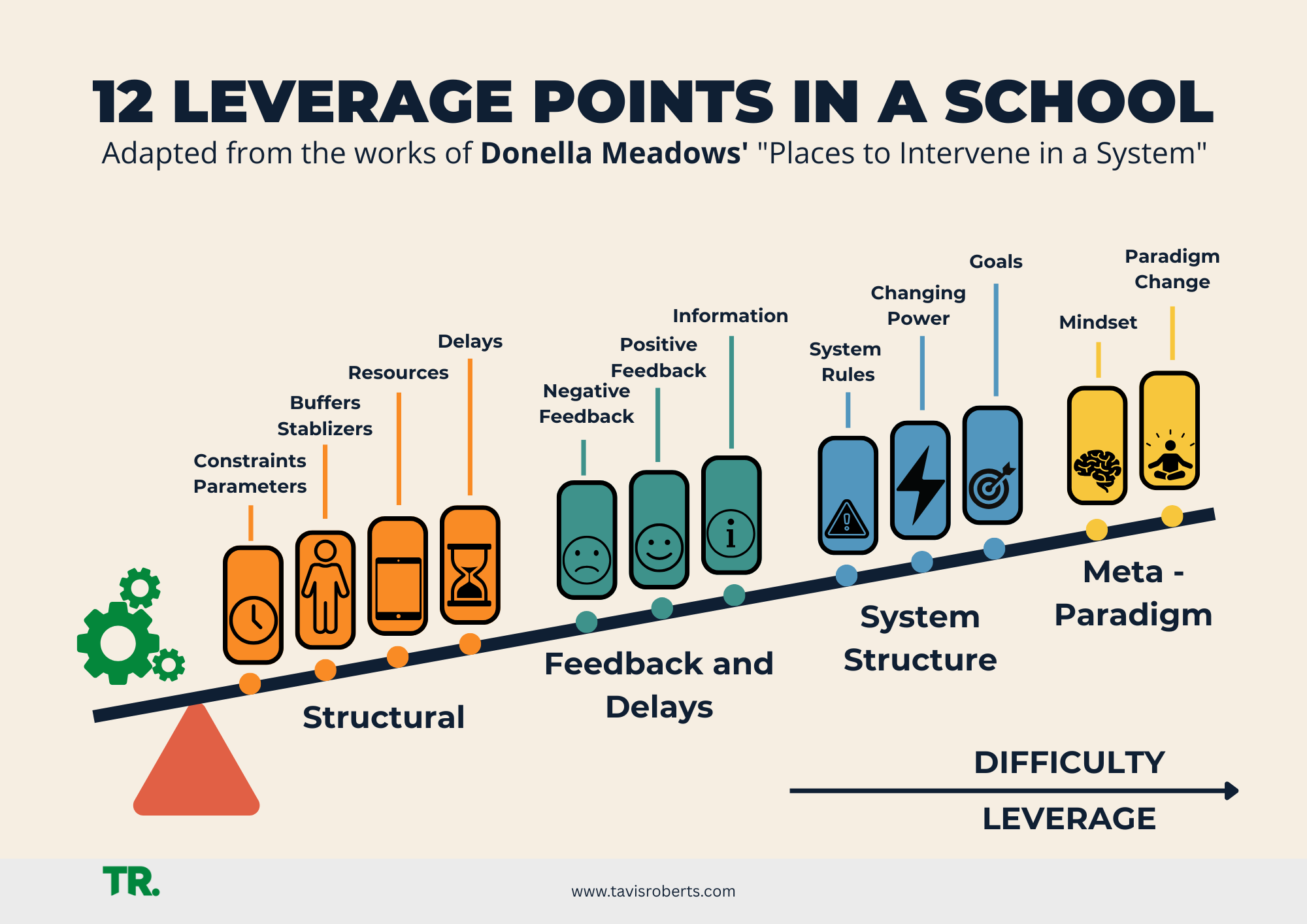
To help you lead at this level, I’ve adapted Donella Meadows’ “12 Places to Intervene in a System” into a school-specific model. It maps out the most common intervention points we engage with as directors, coordinators, and strategic thinkers. Each level gets more effective—and harder to implement. The result is a clear, visual map of where to act depending on what you want to change.
Structural Elements (Low Leverage)
These are the operational details that keep a school running: schedules, resources, and small adjustments to daily routines. They are the simplest areas to change and often provide quick relief when something is not working smoothly. However, these changes rarely influence the bigger direction of the school or solve recurring problems in a lasting way.
- Constants / Parameters — Adjusting class start times, changing out-of-bounds areas, or capping group sizes.
- Buffers / Stabilizers — Adding a second duty teacher, increasing volunteer spots, or keeping a list of substitute teachers.
- Resources (Stocks & Flows) — How many pieces of sporting equipment, devices exist—and how they’re shared and where they are located. Tracking the number of library books in circulation vs overdue.
- Delays — The time lag between decision → communication → action, like when an IT help ticket is created and when support arrives.
💡 Why it matters: Quick fixes feel productive, but don’t really change the underlying problems. Use them like short-term band-aids and adjust with care, not obsession.
Feedback & Delays (Medium Leverage)
Feedback and communication systems shape how students, staff, and parents understand what is expected of them and how the school is doing. When feedback loops are clear and timely, behavior and performance improve naturally. When they are slow, inconsistent, or invisible, frustration builds and problems are compounded.
- Negative Feedback Loops — Discipline procedures, student attendance tracking, or staff performance reviews.
- Positive Feedback Loops — House points, “student of the week,” or other forms of recognition and awards that amplify desired behaviors.
- Information Flows — How parents, staff, and students actually receive and give updates: meetings, newsletters, student homeroom, instant messaging, surveys, and suggestion boxes.
💡 Why it matters: Most school problems aren’t caused by “bad people” but by invisible or broken feedback loops and information flows that they are frustrated with. Fix the loop and the information flow. Behaviors will start shifting—often without extra effort.
System Structure (High Leverage)
System structure defines who makes decisions, how responsibilities are distributed, and what rules guide everyday practice. These are harder to change than schedules or procedures, but they have a far stronger influence on long-term outcomes. Adjusting structures changes not just one event, but the way all future decisions are made.
- Rules of the System — Shifting from principal-only hiring decisions to panel interviews, including teachers, students, and parents. Requiring departments to co-create budgets that include student voice. Requiring all middle school units to be connected to a United Nations SDG goal.
- Power to Change the Structure — Allowing the student council to request changes to cafeteria menus and extra-curricular programs. Can teachers vote on themes and presentations for Professional Development days?
- Goals of the System — Is this event for marketing, student leadership, or community building?
💡 Why it matters: Once you change the rules or goals, you’ve changed every future outcome. This is where real strategy lives—but be prepared for some to resist it because “that’s too hard” or “this is how we’ve always done it.”
Paradigm & Meta-Paradigm (Max Leverage / Visionary Difficulty)
Paradigms are the shared beliefs and assumptions that define what a school values and prioritizes. When these shift, they reshape how everyone thinks about learning, teaching, and community. Changes at this level are rare but transformative, because they reset the direction of the entire system.
- Mindset of the System — Are we school-centered—where teachers deliver content—or learner-centered—where teachers coach inquiry? What if instead of discussing behavior and grades at three-way conferences, we discussed the child’s own goals for the subject, led by the student?
- Power to Transcend Paradigms — What if we stopped running events as performances and started running events as learning labs? What if our grades were narrative-based instead of numerical, or there were no final exams?
💡 Why it matters: This is visionary work. At this level, you’re not tweaking logistics—you’re redesigning the machine.
How to Use This as a Director
Each week, ask yourself:
- Am I solving problems at a low-leverage level (timing, resources) when I should be rethinking the structure or goal?
- Am I solving the right problem, or just the most visible one?
- Where is resistance coming from: a broken loop, a bad rule, or a bigger mindset issue
Examples:
School Events
- Low leverage = add another person to help.
- High leverage = create an event template and assign ownership by role, not person.
- Max leverage = redefine what “events” are meant to achieve in our school culture.
Discipline System
- Low leverage = adding more categories for detention behaviors.
- High leverage = introducing restorative practices instead of punitive measures.
- Max leverage = redefining discipline as character growth, not rule enforcement.
Expert Tip: Giving Time, Time
Every level of intervention needs time in proportion to its difficulty and the outcome you are aiming for. Quick fixes at the structural level might show results within a week, but shifts in system structures or paradigms often take months or even years to bear fruit. Leaders sometimes abandon high-leverage changes too early because they expect quick results. Patience is part of the strategy—big shifts require giving the system space to adjust, stabilize, and then show its impact. Being a leader during this time means staying resilient, holding true to the vision, doing the everyday work that keeps things moving, and absorbing the doubts and complaints that come when others feel progress is too slow.
📥 Download the Visual Framework (attached) and use it in strategic planning, PD, or your next leadership team huddle. Print it. Pin it. Carry it into meetings when the noise gets loud.
Coming Up Next
We’ve covered 10 mental models so far. In the next email, you’ll get a final summary—and an invitation to turn these insights into downloadable systems you can actually use.
—Tavis
P.S. Share this with your team. It’s licensed for non-commercial school use—print it, discuss it, even build a reflection session around it.